Wash
SUDS IS THE WORD
Our pH balanced washes provide rich suds for a quality clean and lubrication to protect your vehicle's surface while removing contaminants. Washing frequently is essential to maintaining that showroom new appearance.
TRADITIONAL HOSE AND BUCKET
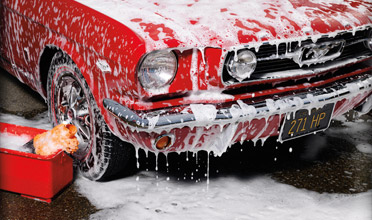
Always wash your vehicle in the shade out of direct sunlight. Pre-rinse to loosen contaminants. Dilute your preferred Griot's Garage car wash into your bucket with the recommended ratio of water to soap. Using one of our many quality wash mitts or pads clean from the top down. Rinse your mitt frequently to release dirt and debris in a second bucket filled with clean water. Do not allow car wash solution to dry on the paint surface. Re-soap as necessary, then rinse
FOAMING SYSTEM
The BOSS™ Foaming System gives you a thorough wash while helping to prevent wash-induced scratches. The system consists of two washes, a gloss enhancer, and an innovative foam cannon delivery system. Application can be as easy as screwing a bottle of concentrate onto the cannon and letting the foam fly. Spray foam from a distance of 3 to 4 feet in slow, even, overlapping passes to ensure total coverage. The liquids have long dwell times but be sure to rinse before the solution dries on your paint.
RINSELESS WASH & WAX
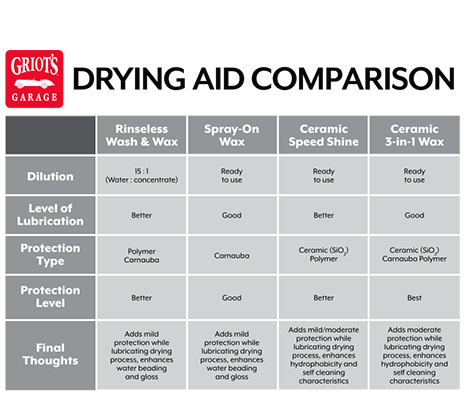
Enjoy dramatic water savings and add gloss and protection to the equation with Rinseless Wash & Wax. Simply add 1 ounce to 2 1/2 gallons of water (320:1) in a bucket, soak a Microfiber Wash Pad or Microfiber Plush Edgeless Towel in the solution, and glide it across your paint. Then dry immediately using a PFM® Terry Weave Towel. For heavier contamination, pre-soak surface with Rinseless Wash & Wax at a 15:1 ratio by using our 15:1 Dilution Bottle.
SPRAY-ON CAR WASH
When traditional bucket washing is not convenient or compliant to local laws, our Spray-On Car Wash provides a safe alternative. Simply pre-saturate a Microfiber Plush Edgeless Towel with Spray-On Car Wash, spray a liberal amount onto your vehicle, gently wipe surface in one direction frequently rotating to a clean area of the towel, and flash dry with a PFM Terry Weave Towel. An average car can be washed in 10 minutes or less.
griot's garage: washing basics
RICHARD'S TOP WASHING TIPS


Always wash a cool surface in the shade or out of direct sunlight.

Always use two wash mitts while washing. One for the top to the mid-section of the vehicle and another for the mid-section down.

Employ the two-bucket method when washing your car. Use one bucket for soaping up your paint and the second as a rinse reservoir.

To reduce standing water and speed up the drying process, spray a smooth stream of water across panels from top to bottom to promote sheeting action.

Always consult and obey local water laws. Should traditional "bucket washing" be prohibited, utilize our Spray-On Car Wash or Rinseless Wash & Wax as a safe alternatives.
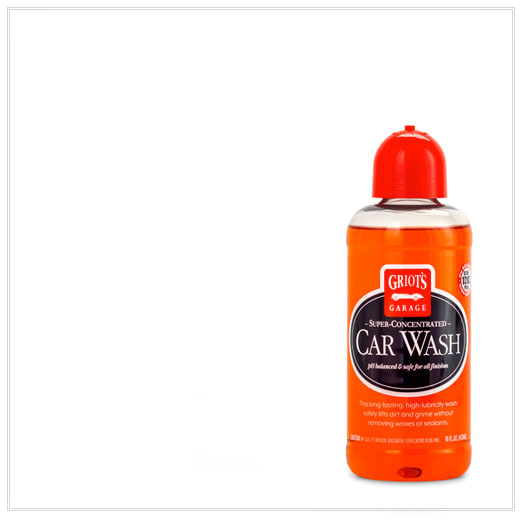
OUR MOST POPULAR CAR WASH
SHOP CAR WASH >